
The ROI of exoskeletons: why investing in workforce support pays off
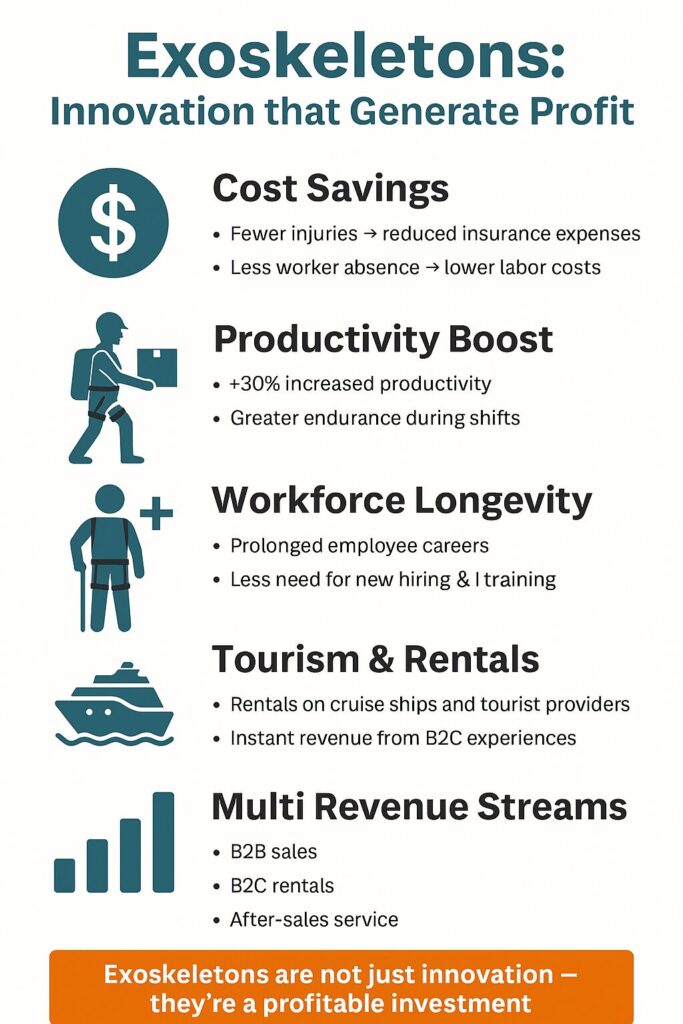
For many European companies, the idea of exoskeletons still feels futuristic. But the question executives should ask is not “Is this possible?”, it’s “Does this make financial sense?”
The answer is clear: yes. Exoskeletons deliver measurable returns by reducing injuries, improving efficiency, and extending the working life of employees.
The Hidden Costs of Workplace Fatigue
Musculoskeletal disorders (MSDs) are among the most common occupational health issues in Europe. They lead to:
- Absenteeism – sick leave can last weeks or months.
- Lower productivity – workers tire faster, leading to reduced output.
- Staff turnover – fatigue and pain drive employees to leave high-demand jobs.
- Insurance & compensation costs – claims can rise sharply in injury-heavy industries.
These costs are rarely visible on a balance sheet, but they erode margins year after year.
How Exoskeletons Change the Equation
By supporting the body, exoskeletons:
- Reduce fatigue by 30% or more.
- Prevent injuries that would otherwise require medical leave.
- Improve consistency and accuracy in physical tasks.
- Enable workers to perform demanding roles for longer careers.
This means fewer hidden costs and higher, sustainable output.
Calculating ROI
Let’s look at a logistics hub with 100 workers:
- Average cost of a back injury claim: €25,000–€40,000
- Average sick leave days per worker per year: 8–12
- Estimated productivity loss due to fatigue: 10–15%
If exoskeleton adoption prevents just 2 serious injuries per year and reduces fatigue-related inefficiency by 5%, the savings can reach hundreds of thousands of euros annually, more than covering the cost of equipping staff.
A Long-Term Investment
Exoskeletons are durable, modular, and designed for years of use. With proper training and maintenance, companies can benefit from:
- 3–5 year service life per unit
- 24-month warranty & repair network (Kenqing’s certified centres in China)
- Easy scaling from pilot programs to full workforce deployment
Beyond Numbers: Employer Branding
There’s also a strategic benefit: adopting exoskeletons positions your company as a forward-thinking employer that values worker wellbeing. This enhances your reputation, helps attract skilled employees, and can strengthen client relationships.
Conclusion: ROI You Can Feel
Exoskeletons are not just machines, they are a workforce multiplier. They pay for themselves by reducing risks, improving productivity, and protecting human capital.
At Eazy Walking, we work with European companies to design tailored exoskeleton programs: from small pilots to large-scale deployments.